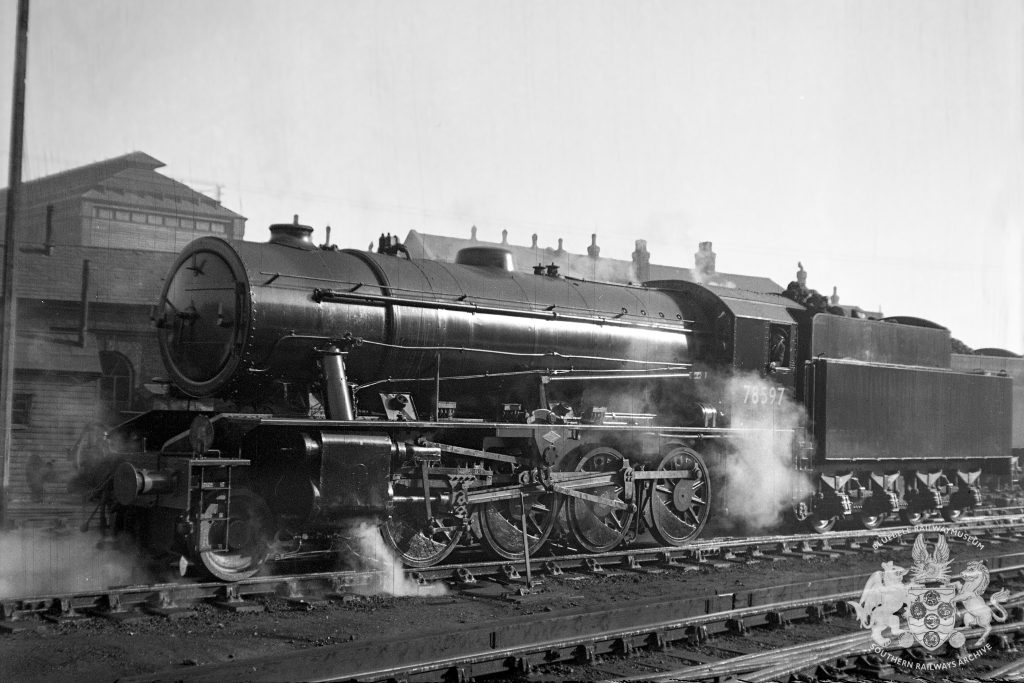
On 29 January 1949, Joe Kent took this image of WD 2-8-0 78597 at Brighton Shed (75A). Records show that the locomotive had been in Brighton Works earlier in January, which probably accounts for its seemingly ex-works condition in the photograph.
78597 had been constructed by the North British Locomotive Company at its Queen’s Park works in Glasgow and had entered War Department service in January 1944. At the time the photograph was taken it was allocated to Hither Green (73C).
First introduced in 1943 for war service both at home and overseas, a total of 935 WD 2-8-0s were built. Around 200 remained overseas after the war with the majority working in the Netherlands. 733 were eventually taken into British Railways stock and renumbered in the 90000–90732 series, 78597 itself becoming 90390 in April 1951.
The LMS Stanier Class 8F design had been chosen by the Railway Executive as its standard freight locomotive in 1939. The WD 2-8-0 was designed by Robert Riddles (later CME for British Railways) to cover a similar role and be suitable for use in both the UK and war-torn Europe, but be easier and cheaper to build and operate. Changes included a steel rather than copper firebox, fabricated plates in place of steel castings and the replacement of the three-axle tender with a four-axle version to cope better with poor track conditions.
Newly renumbered, 90390 was transferred away to Newton Heath (26A) in May 1951 and spent much of the rest of its career at the depot and other locations around the Manchester area. It went to Frodingham (36C) in June 1965 and was withdrawn from there on 19 September. It was scrapped at Drapers of Hull during December.
Only one WD 2-8-0 is preserved: 79257 which had ended up working in Sweden was eventually repatriated and overhauled. Although it was never a BR locomotive, it has now assumed that identity using the next available number in the series, 90733. It is now based on the Keighley and Worth Valley Railway.
Photo: Joe Kent [152513]